

Organ Science
Key takeaways
- An integrative study of five biological clock types found all cross-clock correlations below r=0.2, meaning epigenetic, proteomic, transcriptomic, metabolomic, and telomere clocks are measuring largely non-overlapping biological phenomena.
- GrimAge, the strongest-performing epigenetic clock, achieves its accuracy partly by estimating seven plasma proteins from DNA methylation patterns — making direct protein measurement the more proximate signal.
- In the UK Biobank (n=44,498, 17-year follow-up), people with eight or more aged organs carried a hazard ratio of 8.3 for all-cause mortality; an aged brain specifically raised Alzheimer's hazard ratio to 3.1, independent of APOE genotype.
- No published test–retest reliability data (ICC) exists for proteomic organ age gaps, and no published intervention study has demonstrated that plasma-proteomic organ age can be lowered — both are open questions the field has not yet answered.
- No biological age test — Function, Superpower, or Vero — is FDA-cleared; all occupy a consumer informatics category, not a clinical diagnostic one.
Biological age tests disagree with each other because they measure different things. Function Health calculates biological age from nine standard blood chemistry markers — the same kind your doctor orders at a physical. Superpower assembles a composite from a broader routine panel. Vero OrganAge™ does something categorically different: it measures proteins that leak into your blood directly from specific organ tissues, then uses machine learning to estimate how old each of eleven organs looks relative to its chronological age. The underlying technologies are not competing versions of the same idea. They are answering different questions — which is why the same blood, on the same day, can produce three different numbers.
Why does the same blood give three different answers?
One tester. Chronological age 52. Three platforms, tested across 2025–2026: biological ages of 37.3, 38.0, and 45.2 — a spread of nearly eight years, from the same body, from overlapping blood draws.
The tempting explanation is that one of those platforms is wrong. The more accurate one is that all three may be right — and the divergence is evidence of something more interesting than measurement error.
Here's the crux: an integrative study of five biological clock types — epigenetic, proteomic, transcriptomic, metabolomic, and telomere-based — in approximately 3,000 subjects found that correlations between all biological aging indicators were small, with all r values falling below 0.2 (Kok et al., eLife). That's consistent with the broader literature: epigenetic clocks correlate with each other at r=0.3–0.5, and across omics types correlations fall below 0.2, with DunedinPACE correlating with Horvath at approximately r=0.13 (Higgins-Chen et al., Nature Aging 2022).
These instruments don't disagree because one is noisier. They disagree because they are measuring different biological phenomena. If you don't know what each tool is actually doing, you can't know what any of them is telling you. That's the legibility problem this piece is designed to solve.
What is Function actually measuring?
Function Health computes biological age using Phenotypic Age — a validated composite of nine standard clinical markers including albumin, creatinine, glucose, and mean cell volume (Liu et al., PLOS Medicine 2018). The model was trained to predict 10-year mortality, and it does so at AUC 0.88, compared to 0.86 for chronological age alone — a real improvement, though a modest one.
That's worth sitting with for a moment. A difference of 0.02 in AUC isn't nothing: across a large population, it translates into meaningful risk stratification. But it also tells you something about the ceiling. Nine clinical markers are doing most of their predictive work at the aggregate level. They can tell you that something in your blood chemistry looks older than your years. They can't tell you which organ is driving the signal — or whether it's one organ running hot while everything else looks fine.
The advantage of Function's approach is real: accessibility, cost, and the fact that nine standard biomarkers are already collected in routine clinical workflows. The limitation is resolution. A single-number composite is, by design, averaging across signals that may be moving in opposite directions.
What is Superpower actually measuring?
Superpower offers biological age as part of a 100+ biomarker panel that, as described on its product pages and in third-party coverage (Fierce Healthcare), spans heart and vascular health, liver, kidney, metabolic, hormonal, immune, and thyroid markers. The specific methodology for converting that panel into a biological age number is not publicly disclosed beyond the composite framing.
This is a wider net than Function's nine markers, and a wider net catches more signals. That's genuinely useful — particularly for someone who has never had comprehensive bloodwork and wants an orientation to where their routine chemistry sits.
But the measurement layer is the same: standard blood chemistry, assembled into a composite. Superpower was not designed to detect that your heart is aging twelve years ahead of your kidneys. No routine-biomarker panel was. That kind of organ-specific divergence requires a different instrument entirely.
What does proteomics actually add — and why is GrimAge the key to understanding it?
This is the conceptual pivot, and one fact from the epigenetic clock literature makes it cleaner than any amount of explanation would.
GrimAge is the strongest-performing epigenetic clock in the literature (Lu et al., Aging 2019;11(2):303–327). It works by using DNA methylation — chemical tags on your DNA — to estimate seven plasma proteins, plus smoking pack-years. That's how it achieves its predictive accuracy: by approximating what circulating proteins are doing, through the indirect lens of methylation patterns.
That single fact is the strongest structural argument for measuring proteins directly. If the best methylation clock succeeds partly by estimating plasma proteins, why estimate? Vero OrganAge™ skips the approximation and measures them.
Proteins are what genes actually do. They're closer to biological function than either DNA methylation or routine chemistry markers. Critically, different tissues produce different proteins — which means proteins in blood plasma carry return-address information that a general chemistry panel doesn't. In the foundational organ clock research (Oh et al., Nature 2023;624:164–172), proteins were assigned to organ systems using GTEx expression data at a 4× threshold, with 893 of 4,979 measured proteins qualifying as organ-enriched. Those 893 proteins are the instrument. Each one is a signal from a specific tissue, detectable in blood, measurable at scale.
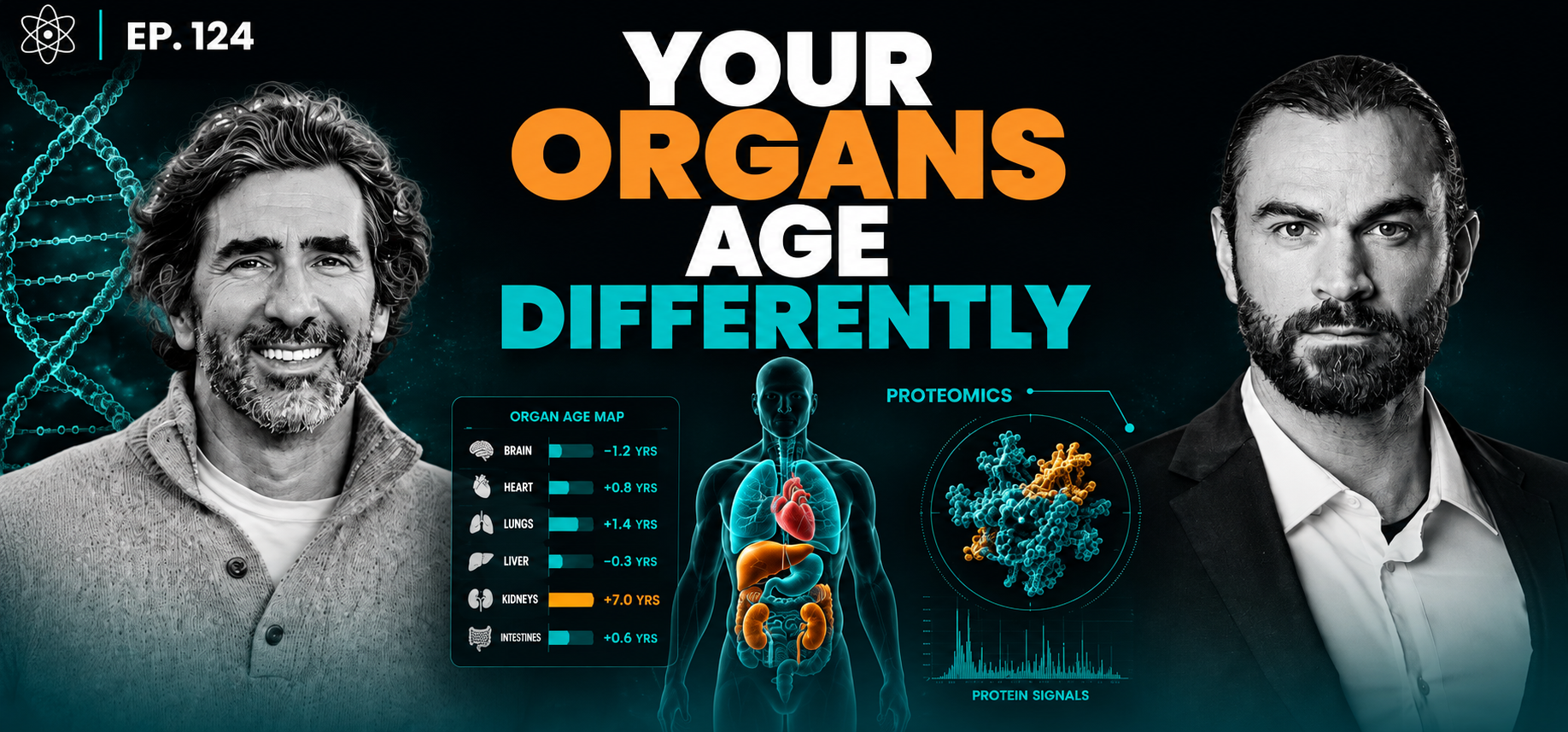
The result is resolution that no routine composite can replicate. Roughly 18.4% of people show strongly accelerated aging in a single organ while looking unremarkable in aggregate (Oh et al., Nature 2023). Nearly one in five people carrying a hidden asymmetry — an organ running significantly older than everything else, invisible to tools that measure everything at once.
"The best methylation clock in the world works partly by estimating plasma proteins. Vero just skips the estimation and measures them directly."
How well does each tier actually predict what matters?
No direct head-to-head trial has been run across these platforms — each evidence base uses different populations, different follow-up windows, and different outcome definitions. What the research does allow is a picture of what each tier has been shown to do in its own right.
Phenotypic Age: AUC 0.88 for 10-year mortality prediction (Liu et al., PLOS Medicine 2018), against 0.86 for chronological age alone.
Proteomic organ age: In the UK Biobank (Oh et al., Nature Medicine 2025;31(8):2703–2711), n=44,498 participants followed for up to 17 years, hazard ratios for all-cause mortality scaled with the number of aged organs: 2–4 organs, HR 2.3; 5–7, HR 4.5; 8 or more, HR 8.3. An aged brain specifically raised Alzheimer's disease hazard ratio to 3.1; a youthful brain corresponded to HR 0.26 — an association independent of APOE genotype. Every 4.1 years of additional heart age corresponded to approximately 2.5× heart failure risk over 15 years (Oh et al., Nature 2023).
Independent replication from Wang et al. (Nature Aging 2026;6:162–180) — not from the Stanford group, but from Andrew T. Chan's lab — validated these models in UK Biobank (n=43,616), China Kadoorie (n=3,977), and the Nurses' Health Study (n=800), with cross-cohort correlations of r=0.93–0.98. Robinson et al. (Nature Aging 2026;6(7):1437–1451), in EPIC and Whitehall II (n=17,473, up to 28 years of follow-up), found proteomic aging performance "comparable to classical lifestyle risk factors" — verbatim from the abstract.
These are not a direct competition with Phenotypic Age. They represent a different kind of evidence, on a different measurement layer, across different populations. The point is not that one tier wins. It's that the proteomic tier is operating from an evidence base that routine composite platforms are not drawing from.
What the clocks don't tell us — the open questions that matter
In a field this prone to overstatement, naming what remains open is what separates a credible explainer from promotional copy.
Test–retest reliability for proteomic organ age gaps has not been published. For methylation clocks, this number exists and is debated — a pooled preprint analysis found most epigenetic clocks achieved ICC >0.9 under consistent laboratory conditions, though earlier-generation clocks like Hannum and PhenoAge showed lower reliability around ICC 0.7–0.8, and a separate analysis (Higgins-Chen et al., Nature Aging 2022) found up to 9 years of technical noise between replicates under varying conditions. For proteomic organ age, no comparable published reliability data appears in the literature. How consistently an individual's result repeats is a question the field hasn't answered yet — and one worth answering before clinical weight is placed on individual results.
No published intervention study has demonstrated that plasma-proteomic organ age can be lowered. One small exercise study — MyoGlu, n=26 sedentary men, 12 weeks, with no described control arm — moved a proteomic clock approximately 10 months. That is a signal, not a finding. Vero's clinical work with Biograph and Atria Health & Research Institution is underway and designed specifically to answer this question. The intervention data is being generated. "We are testing whether organ age responds to intervention" and "organ age responds to intervention" are not the same sentence.
Models were trained predominantly in older adult populations. The original authors of the foundational organ clock research cautioned against applying these models to younger people. Age-range validity is an open question, not a settled one.
No biological age test is FDA-cleared — not Function, not Superpower, not Vero. All three occupy a consumer informatics category, not a clinical diagnostic one. They are not devices that diagnose disease or should direct treatment decisions. Vero's own framing — Vero is directive, not diagnostic™ — captures the correct register.
Does combining clocks give a better picture than any single one?
The finding from Kok et al. (eLife) cuts both ways.
The low correlations across clock types — all below r=0.2 — make a strong case for the divergence story: these tools are not measuring the same thing. But the same study found that a composite index of all five clock types showed more pronounced associations with health outcomes than any individual clock in isolation. Low correlation between instruments, combined with independent predictive validity for each, is the statistical signature of complementary measurement layers.
The field-level implication: different clock types may be capturing different dimensions of the same underlying biological process, and combining them adds information rather than noise. A reader who uses Function today and adds proteomic organ age tomorrow is not switching platforms. They are adding resolution. Routine chemistry tells you what's circulating. Organ-enriched proteins tell you which tissues are generating the signal.
Cell-type resolution is already further along than most people realise. Ding et al. (Nature Medicine 2026) resolved aging across 40+ cell types in n=60,542 participants across three cohorts, using both SomaScan and Olink platforms, finding that 20–25% of people show accelerated aging in a single cell type, with 1–3% aging rapidly across ten or more. The measurement layers are getting finer. The question the field is now working on is not which instrument wins — it's how these layers get integrated into something a clinician or a health-conscious person can actually act on.
How to read your result — whatever platform you're using
Three questions worth asking of any biological age number, regardless of where it comes from.
What substrate is this measuring? Routine chemistry, DNA methylation, and plasma proteins are three different biological layers with low correlations between them. A result means something different depending on which layer it's reading.
What outcomes was the model trained to predict, in what population, over what follow-up window? A model trained on 10-year all-cause mortality in a UK cohort followed for 17 years is not automatically valid for a 35-year-old in a different population. Population, outcome, and follow-up window are not fine print. They are what the number actually means.
Does the result resolve to something actionable? A single aggregate number tells you a direction. An organ-specific result tells you where to look. Neither is a diagnosis, and neither should substitute for clinical judgment. Knowing that your heart looks twelve years older than your kidneys is not a treatment plan — but it is a more specific place to start a conversation with someone who can help you build one.
Vero is directive, not diagnostic™. That line does real work. A measurement that tells you which organ is aging fastest is not telling you what's wrong or what to do. It is telling you where to pay attention — which is more than a number that averages across everything can offer, and less than a clinical workup that follows from that attention. Understanding which of those things you're holding is the difference between using a biological age result well and being confused by it.
The work being done right now — in Vero's clinical partnerships, in the cell-type resolution studies, in the reliability analyses still in progress — is the work of making these measurements more useful, more interpretable, and more honest about what they can and cannot claim. That's the direction. The evidence comes before the promise, not after it.
Sources
- Oh et al., Nature 2023;624:164–172
- Oh et al., Nature Medicine 2025;31(8):2703–2711
- Wang et al., Nature Aging 2026;6:162–180
- Ding et al., Nature Medicine 2026
- Robinson et al., Nature Aging 2026;6(7):1437–1451
- Lu et al., Aging 2019;11(2):303–327
- Higgins-Chen et al., Nature Aging 2022
- Liu et al., PLOS Medicine 2018
- Kok et al., eLife — "An integrative study of five biological clocks in somatic and mental health"
- Nature Aging 2026 — "Proteomic aging clocks in epidemiological studies: advances, applications and prospects"
- Preprint — "Biological versus Technical Reliability of Epigenetic Clocks," bioRxiv 2025 (not peer-reviewed)
- TIME — Function Health methodology coverage
- Fierce Healthcare — Superpower Series A and product description
Early access
Discover your OrganAge™
Join our waitlist to get priority access to OrganAge™ and Vero Compass™ as they become more widely available.
Get early accessEarly access
Discover your OrganAge™
Join our waitlist to get priority access to OrganAge™ and Vero Compass™ as they become more widely available.
Get early access