
Organ Science
Key takeaways
- Your genome remains largely static throughout life, whereas your proteome reflects real-time cellular activity, measuring current biological function rather than potential genetic risk.
- A standard blood panel measures a handful of proteins. A proteomic panel measures thousands from the same sample.
- Proteins are matched to organs statistically: a protein counts as organ-enriched when one tissue produces it several times more than any other.
- Comparing an organ's predicted biological age to your chronological age establishes an age gap, revealing whether a specific organ system is aging relative to a peer baseline.
- Proteomics provide high-resolution proxies strongly tied to disease risk, but establishing them as validated healthspan biomarkers requires clinical trials proving that lowering an organ's biological age directly improves health outcomes.
What Proteomics Is
Your genome is the instruction set you were born with and it barely changes. Your proteome is what those instructions are actually producing right now in real time, the full set of proteins circulating in your body at this moment. It shifts with age, illness, physical stress, and lifestyle interventions. While genomics indicates potential health risks, proteomics provides a direct measurement of current biological activity.
Proteomics is simply the study of proteins in your body and their functions. A standard blood panel checks a handful of isolated markers one at a time, like a cholesterol score or a single liver enzyme. A proteomic panel measures thousands of proteins simultaneously from a single blood sample.
Why Proteins
Proteins are the functional components of cellular biology. They metabolize nutrients, mediate immune responses, repair tissue, and coordinate signaling across organ systems. As your organs function and age, they shed distinct proteins directly into your bloodstream.
This means a single tube of blood carries organ-specific biological signals. The signal is subtle and mixed with everything else in circulation, which is why reading it reliably requires advanced proteomic assays and large population-scale datasets.
Where a standard lab panel asks a few isolated questions, a proteomic panel provides a high-resolution snapshot of your underlying biology.
The Value of Comprehensive Proteomic Scale
Scale is what makes organ- and cellular-level resolution possible. Two primary platforms dominate current research: SomaLogic’s aptamer-based SomaScan and Olink’s antibody-based Explore. The foundational organ-aging research published in Nature in 2023 utilized SomaScan v4, measuring 4,979 proteins per sample (4,778 passing quality control). The 2025 follow-up study in Nature Medicine utilized Olink Explore to analyze 2,916 proteins. Commercial assays now measure up to 11,000 proteins.
Measuring a higher quantity of proteins does not automatically guarantee better science, but broader measurement increases coverage, maximizing the chance of capturing specific organ-enriched proteins. This expanded mapping provides foundational data to train next-generation Organ and Cell Clock technologies.
Mapping Circulating Proteins to Specific Organs
Proteins in circulation do not inherently signal their tissue of origin. Establishing an organ-specific link requires mapping protein levels against gene expression atlases that document tissue synthesis volumes.
A protein is classified as organ-enriched when a single tissue produces it at significantly higher levels than any other. In the 2023 Nature study, 856 of the 4,778 analyzed proteins met this threshold, forming the foundation for eleven distinct organ-specific models: adipose tissue, artery, brain, heart, immune system, intestine, kidney, liver, lung, muscle, and pancreas.
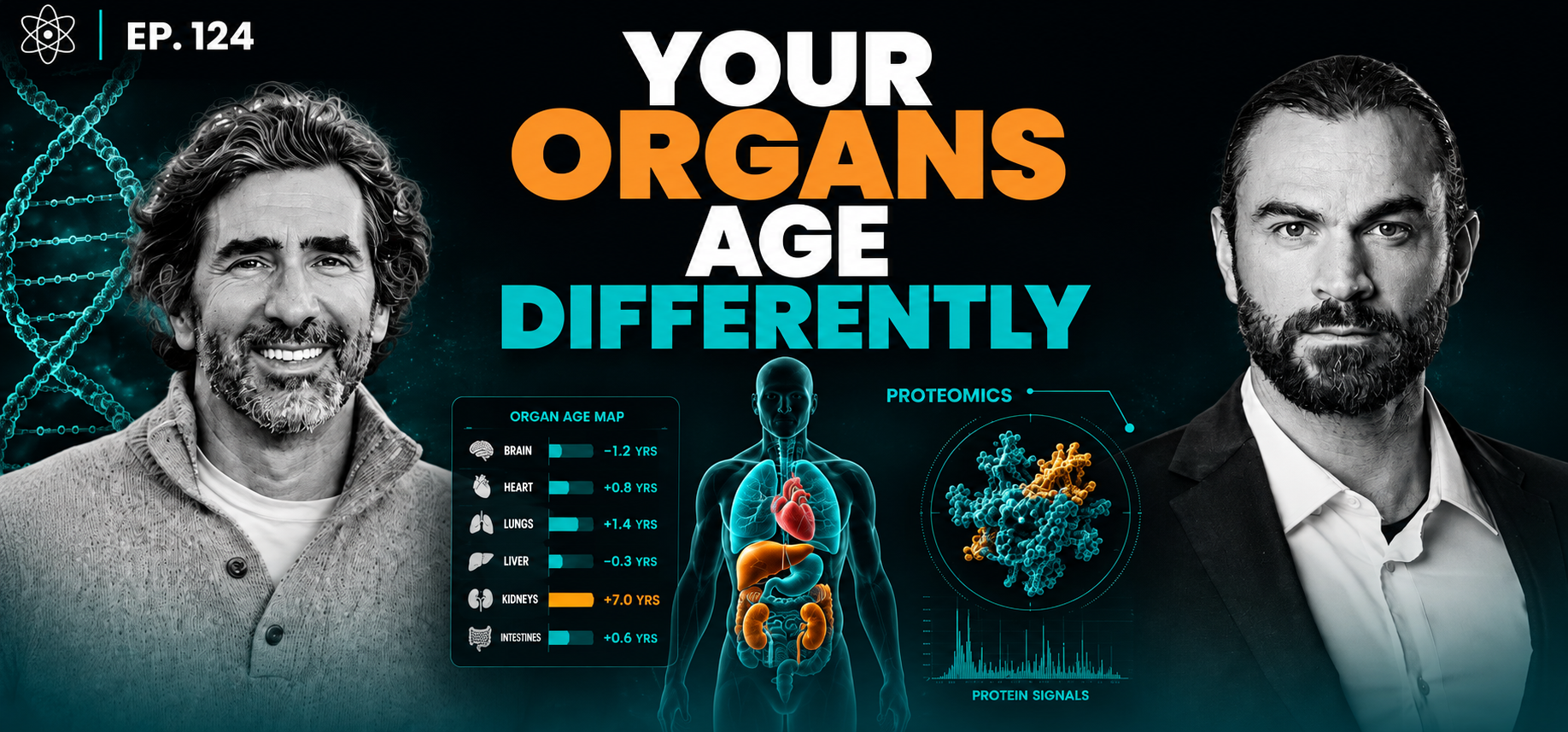
Each model estimates biological age based exclusively on that organ’s specific protein profile. Comparing an organ’s predicted biological age to chronological age establishes an organ age gap. A positive age gap indicates accelerated biological aging within that specific system.
Key Findings in Proteomic Aging Research
Two landmark studies demonstrated that organ-specific proteomic profiling turns theoretical aging research into actionable biological intelligence.
The 2023 Nature study evaluated 5,676 adults across five independent cohorts, demonstrating that organs age at distinct rates within the same individual. Approximately 18.4% of participants exhibited accelerated aging in a single organ, while 1.7% showed accelerated aging across multiple systems. An accelerated heart age gap correlated with significantly higher risk of heart failure, while accelerated brain and vascular aging predicted Alzheimer's progression with accuracy comparable to established biomarkers.
The 2025 Nature Medicine study expanded this research to 44,498 individuals within the UK Biobank. Biological brain age emerged as the strongest single predictor of overall mortality risk. Furthermore, multi-organ aging risks demonstrated cumulative effects: individuals with accelerated aging across two to four organs faced 2.3 times higher mortality risk, while those with accelerated aging across eight or more organs faced an 8.3-fold increase over fifteen years.
- Organ aging signatures in the plasma proteome track health and disease — Nature, 2023
- Plasma proteomics links brain and immune system aging with healthspan and longevity — Nature Medicine, 2025
Current Scientific Boundaries and Considerations
An honest account of the science has to include its limits, which traditional biological age tests often obscure.
Biological age testing is not a medical diagnosis: An organ age gap represents a statistical comparison against a reference population cohort, not a diagnostic test for disease. An accelerated organ age score serves as a biological signal to guide targeted precision interventions with a clinician, rather than a definitive clinical diagnosis.
The findings reflect risk associations: The studies show that organ age gaps predict long-term risk across large groups. That is not the same as showing that changing your organ age score changes your clinical outcome. Measuring how organs respond over time creates a continuous feedback loop, but proving long-term risk reduction remains an active area of research.
Translating proteomics into healthspan biomarkers: Plasma proteomics provides high-resolution circulating proxies of organ and cellular health. However, establishing these clocks as formally recognized biomarkers of healthspan requires ongoing clinical research. Current studies demonstrate that organ age gaps correlate strongly with disease risk across populations. The next phase of clinical research focuses on outcomes: proving that targeted interventions that lower an organ's biological age directly reduce disease incidence and extend healthy lifespan. As longitudinal trials continue to connect molecular changes to clinical endpoints, proteomic clocks are advancing from observational models into validated biomarkers designed to measure real-time intervention response.
Early access
Discover your OrganAge™
Join our waitlist to get priority access to OrganAge™ and Vero Compass™ as they become more widely available.
Get early accessEarly access
Discover your OrganAge™
Join our waitlist to get priority access to OrganAge™ and Vero Compass™ as they become more widely available.
Get early access