
Organ Science
Key takeaways
- GrimAge, the strongest epigenetic mortality predictor, achieves its predictive power by using DNA methylation to estimate seven plasma proteins plus a smoking surrogate — making it an indirect protein proxy by design.
- Approximately 18.4% of people show strongly accelerated aging in a single organ while appearing unremarkable overall, a pattern a composite biological age score cannot detect (Oh et al., Nature 2023).
- Independent replication across UK Biobank, Chinese, and US cohorts produced cross-cohort correlations of r = 0.93–0.98 for proteomic organ clocks — the strongest generalizability signal in this literature (Wang et al., Nature Aging 2026).
- Robinson et al. (Nature Aging 2026, n = 17,473, 28 years) found proteomic aging predicted mortality at a level comparable to classical lifestyle risk factors collectively — a finding that complicates superiority claims without undermining the organ-specificity argument.
- No published test–retest reliability data exists for proteomic organ age gaps, no intervention study has demonstrated these clocks can be lowered, and no biological age test — proteomic or epigenetic — is FDA-cleared.
Proteomic aging clocks measure biological age by reading proteins circulating in your blood plasma — proteins that leak from specific organ tissues as they age. Epigenetic clocks, the older and more commercially established approach, measure chemical tags on DNA called methylation marks. The two approaches are not equivalent. The leading epigenetic clock, GrimAge, works by using those methylation marks to estimate seven plasma proteins, then building a mortality predictor from those estimates. Proteomics removes the estimation step entirely. It also does something epigenetic clocks cannot: it resolves aging at the level of individual organ systems, from a single blood draw.
Two ways to measure a body's age — and why the difference matters
Your body is aging, but not at the rate your birth certificate suggests. Molecular damage accumulates unevenly across tissues, and the gap between your chronological age and your biological age — how fast your cells and organs are actually deteriorating — is where your real health risk lives.
The question is how to measure it. Over the past two decades, two approaches have generated the most research attention and the most commercial products. The first reads chemical modifications on your DNA — methylation marks that accumulate with age in patterns a trained model can use to estimate how old your biology looks. These are epigenetic clocks. The second reads proteins circulating in your blood plasma — proteins shed by specific tissues as those tissues age. These are proteomic clocks.
Both are legitimate scientific instruments. Both predict mortality. Both are improving rapidly. But they are not measuring the same thing, they do not agree with each other in any meaningful way, and they offer fundamentally different types of clinical information. Understanding why starts with looking carefully at how the best epigenetic clock actually works.
What epigenetic clocks actually measure — and what GrimAge reveals about the ceiling
Most people assume epigenetic clocks are reading aging directly off your DNA. They are not. They are reading chemical tags — methylation marks — that happen to correlate with age, and using statistical models to translate those correlations into an estimated biological age.
The distinction matters most when you look at GrimAge, the strongest single-clock mortality predictor in the literature. GrimAge does not generate its mortality prediction from methylation patterns alone. It works by using DNA methylation to estimate seven specific plasma proteins — including PAI-1 and GDF15 — plus a surrogate for smoking pack-years, and then combines those estimates into a composite score (Lu et al., Aging 2019;11(2):303–327).
The field's most powerful epigenetic clock works by approximating proteins from DNA methylation, then building its mortality predictor from those approximations. It is an indirect protein proxy — methylation as a lens to infer what is happening in your plasma.
This is not a critique of the scientists who built GrimAge. It is a remarkable piece of computational biology. But it is a signal about where the biological information is actually concentrated. If the best methylation-based instrument achieves its predictive power by triangulating toward protein levels, then measuring those protein levels directly removes an entire layer of estimation — and opens the door to a kind of clinical resolution that methylation simply cannot produce.
The reliability problem: how much noise is in the signal?
Before asking whether a biological age test predicts anything meaningful, a more basic question deserves an answer: does it give you the same result twice?
For epigenetic clocks, the answer is increasingly well-documented — and uncomfortable. Technical noise alone produces deviations of up to nine years between replicates for six prominent epigenetic clocks (Higgins-Chen et al., Nature Aging 2022). Two blood draws from the same person, processed in the same lab, can return biological ages nearly a decade apart. Not because anything changed biologically, but because the measurement itself is imprecise.
A 2025 preprint — pooling data from four independent studies, not yet peer-reviewed — extends this picture further, finding that most epigenetic clocks achieve only "moderate" to "good" reliability, with ICC scores roughly in the 0.4–0.7 range and none reaching the "excellent" threshold. The peer-reviewed Higgins-Chen finding is the anchor here; the preprint adds supporting signal, not settled science.
There is a compounding problem. Epigenetic clock estimates are sensitive to platform updates and data-processing pipeline changes. Run the same samples through two slightly different versions of the same analytical pipeline and you may not get comparable results — which makes longitudinal tracking technically fraught. The question most people actually want to answer — am I aging faster than last year? — is difficult to answer reliably when your measurement tool cannot consistently agree with itself across runs.
These are not fatal flaws. Epigenetic clocks remain valuable research instruments with a decade of epidemiological literature behind them. But they set a bar any clinically meaningful biological age measure needs to clear — and the equivalent reliability data for proteomic organ age gaps has not yet been published. That gap is named below, where it belongs.
What proteomics can see that methylation cannot
The structural advantage of proteomic clocks is not aggregate predictive power — it is resolution.
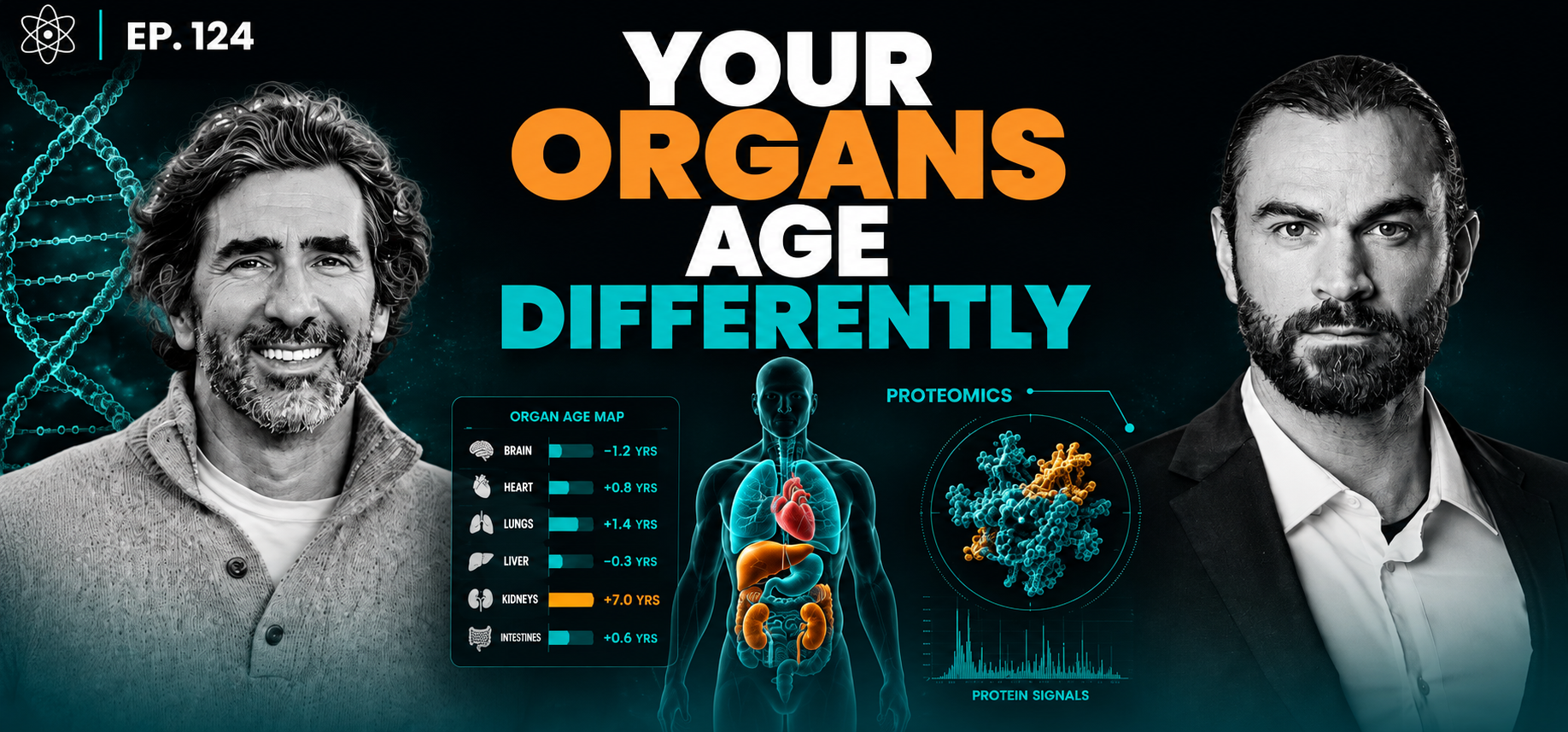
Different organs age at different rates. Your brain can be biologically 10 years older than your chronological age while your kidneys look perfectly healthy. Your heart can be accumulating damage quietly while every other system appears unremarkable. A single composite biological age score — whether derived from methylation or any other source — cannot see this. It averages over the heterogeneity, and in doing so, loses the information that matters most clinically.
Proteomic clocks can see it because organs shed their own proteins into the bloodstream. Measure enough of the right proteins — those expressed at a 4× threshold above background in a specific organ, defined against the GTEx reference database — and patterns emerge that are specific to individual tissues. This is not a theoretical advantage. It is what the foundational study demonstrated empirically.
Oh et al. (Nature 2023;624:164–172) measured 4,979 plasma proteins in 5,676 people across five cohorts, identifying 893 organ-enriched proteins distributed across 11 organ systems. The finding that followed is the most important single number in this field: approximately 18.4% of people show strongly accelerated aging in a single organ while appearing unremarkable overall. One in five people with an organ quietly deteriorating at a rate their overall health metrics would never flag.
The same paper found that one standard deviation of organ age gap — roughly four years — was associated with 15–50% higher all-cause mortality. Every 4.1 years of additional heart age corresponded to approximately 2.5× heart failure risk over 15 years (Oh et al., Nature 2023;624:164–172).
A composite methylation score produces no equivalent decomposition. It cannot tell you which system is leading the decline, because it was not designed to look at systems independently. That is not a shortcoming better algorithms will fix — it is a substrate limitation. The DNA methylation signal does not carry organ-specific information in the same way plasma proteins do.
What the clinical evidence actually shows
The foundational paper established the biology. The evidence that followed established the scale.
Oh et al. (Nature Medicine 2025;31(8):2703–2711) moved to the UK Biobank — 44,498 people, up to 17 years of follow-up. An extremely aged brain was associated with Alzheimer's disease at a hazard ratio of 3.1. A youthful brain — the same metric in the protective direction — was associated with a hazard ratio of 0.26. These effect sizes are comparable to carrying one copy of APOE4 or two copies of APOE2, and they held independent of APOE genotype. The biological age of your brain is predicting your Alzheimer's risk above and beyond the genetic risk factor the field has spent decades studying.
Mortality risk by aged-organ count told a similarly stark story. People with 2–4 accelerated organs showed a hazard ratio of 2.3 for all-cause mortality. With 5–7 organs accelerated, that rose to 4.5. With 8 or more: 8.3 (Oh et al., Nature Medicine 2025;31(8):2703–2711).
Then came independent replication — and this matters more than any single study. Wang et al. (Nature Aging 2026;6:162–180) was not a Stanford paper. The senior author was Andrew T. Chan. The team built organ-specific aging clocks in the UK Biobank (n=43,616) and validated them in two external cohorts: China Kadoorie (n=3,977) and the Nurses' Health Study (n=800). Cross-cohort correlations landed at r=0.93–0.98 — the strongest generalizability signal in this literature. A refined 10-protein brain clock retained approximately 88% of its dementia-predictive accuracy. An independent group, different populations, different continents, same result.
Ding et al. (Nature Medicine 2026), working across 60,542 people using both SomaScan and Olink platforms, pushed resolution further — to individual cell types. Using single-cell transcriptomic reference data, the study resolved aging patterns across more than 40 cell types. Twenty to twenty-five percent of people show accelerated aging in a single cell type; 1–3% show it in ten or more. No epigenetic clock approaches this level of biological decomposition.
"Accelerated organ aging predicted disease onset, progression and mortality beyond clinical and genetic risk factors." — Wang et al., Nature Aging 2026;6:162–180
Now the honest complication, which belongs in any rigorous account of this literature. Robinson et al. (Nature Aging 2026;6(7):1437–1451) followed 17,473 people across up to 28 years in the EPIC and Whitehall II cohorts. Their conclusion, verbatim from the abstract: predictive performance for mortality was "comparable to that of classical lifestyle risk factors." Heavy smokers showed approximately +14 months of proteomic age acceleration. Heavy drinkers showed approximately +7 months.
This finding complicates any claim of categorical superiority. If proteomic aging predicts mortality at roughly the same level as knowing whether someone smokes, the practical bar for clinical translation is higher than the early headlines suggested. It does not undermine the organ-specificity argument — knowing which organ system is accelerating carries different clinical information than a composite mortality score — but writing around it would be a misrepresentation. Both findings are real, and a reader of this literature deserves to hold them simultaneously.
The cross-clock disagreement problem — and why mechanism matters
If every biological age clock were measuring the same underlying biology, they would correlate with each other. They do not. Epigenetic clocks correlate with each other at roughly r=0.3–0.5 — meaning two clocks built on the same substrate, applied to the same person, can return meaningfully different biological ages. Across omics types — methylation versus proteins versus metabolites — all correlations fall below 0.2. DunedinPACE, one of the most cited pace-of-aging clocks, correlates with the Horvath clock at approximately 0.13.
This is not a statistical curiosity. It means these instruments are not measuring the same thing. Most of them cannot be right about any given individual at the same time. When the tools disagree, you need a way to decide which one is closer to the underlying biological reality — and a clock anchored in a defined biological mechanism, with organ-level resolution and organ-enriched protein anchors, is a more defensible choice than one constructed as a statistical composite of methylation patterns that correlate with age.
The mechanistic advantage shows up most clearly in the brain and artery clocks. The proteomic signatures driving these organ ages have been linked to specific pathological pathways: synaptic loss, vascular dysfunction, and glial activation in the case of brain aging. These are not just correlations with a composite outcome — they are candidate biological processes that the field already understands in the context of dementia and cardiovascular disease. That interpretability is not available from a methylation composite, and it matters for the translation from population science to clinical application.
What the field hasn't answered yet — and why that's the honest picture
Proteomics has a strong and growing evidence base. It also has open questions that honest reporting requires naming.
Test–retest reliability for proteomic organ age gaps has not been published. For epigenetic clocks, this number is now formally documented — documented in ways that raise real concerns about clinical utility. For proteomic organ clocks, the equivalent number simply does not appear in the literature. Whether the problem doesn't exist or the question hasn't been asked at scale yet is one the field will need to answer before clinical adoption can be fully justified.
No published intervention study has demonstrated that plasma-proteomic organ age can be lowered. One small exercise study — MyoGlu, n=26 sedentary men, 12 weeks, with no described control arm — moved a proteomic clock approximately 10 months. That is a signal. It is not a finding. Vero's ongoing clinical collaborations with Biograph and Atria Health & Research Institution are designed specifically to test whether organ age responds to intervention. Those studies are in progress and have not yet reported results. "We are testing whether X" and "X is true" are different claims, and keeping them distinct is a requirement of honest science communication.
The training populations have skewed older and predominantly European. The age gaps in the foundational models were derived from cohorts aged 39–71, predominantly of European ancestry. Wang et al.'s validation in China Kadoorie (n=3,977) is a meaningful step toward broader generalizability; it is not the last step. How these models perform in younger adults, in more diverse populations, and across the full human lifespan remains an open question.
Platform heterogeneity creates generalizability challenges. Proteomic clocks have been built on SomaScan and on Olink — two different assay platforms with different protein coverage, different technical characteristics, and different cost profiles. How consistently results translate across platforms, and how the field eventually standardizes around a common measurement approach, are questions without settled answers.
No biological age test is FDA-cleared — not proteomic, not epigenetic. This is the field's shared regulatory reality. Biological age measurements are currently research tools. They are not diagnostic. They do not determine treatment. This is not a disclaimer to be buried — it is a condition of responsible use.
Where this leaves someone deciding what to measure
Epigenetic clocks have a decade of published research, several commercial products, and a track record as epidemiological instruments. If you want a single composite biological age score derived from an established platform with a long citation history, those instruments exist and they will give you something real to look at.
But if you want to know not just whether you are aging faster, but which system is driving that acceleration — the kind of information that could actually shape where you focus — proteomics is the only method currently delivering that from a blood draw. The organ-level resolution is not a marketing distinction. It is what explains why 18.4% of people show strongly accelerated aging in one organ while looking unremarkable overall (Oh et al., Nature 2023;624:164–172). A composite score would miss those people entirely.
The open questions are real and should not be minimized. Intervention evidence is being generated now, not yet in hand. Reliability data needs to be published. Training populations need to broaden. These are not reasons to dismiss the clinical evidence already in print — it is substantial, independently replicated across three continents, and its effect sizes in specific organs are clinically meaningful. They are reasons to approach this technology as what it is: a rapidly maturing field, not a finished one.
What you measure shapes what you can understand. Measurement precedes targeting. And the measure that tells you which organ is aging fastest is a different instrument — in kind, not just degree — from one that tells you your average is elevated.
Sources: Oh et al., Nature 2023;624:164–172 · Oh et al., Nature Medicine 2025;31(8):2703–2711 · Wang et al., Nature Aging 2026;6:162–180 · Ding et al., Nature Medicine 2026 · Robinson et al., Nature Aging 2026;6(7):1437–1451 · Lu et al., Aging 2019;11(2):303–327 · Higgins-Chen et al., Nature Aging 2022 · Preprint (not peer-reviewed): Biological vs. Technical Reliability of Epigenetic Clocks, bioRxiv 2025.10.13.682176
Early access
Discover your OrganAge™
Join our waitlist to get priority access to OrganAge™ and Vero Compass™ as they become more widely available.
Get early accessEarly access
Discover your OrganAge™
Join our waitlist to get priority access to OrganAge™ and Vero Compass™ as they become more widely available.
Get early access