


Podcasts
Key takeaways
- OrganAge reads one blood draw against organ-specific models to return a separate biological age for each of 11 organs, rather than one whole-body score.
- Coletta calls the brain the "gateway organ" for its broad influence on the rest of the body.
- His own test flagged an accelerated kidney; a follow-up ultrasound found a benign cyst, prompting him to change his water intake.
- A central theme of the episode: measurement alone doesn't change behavior — a result only matters if it leads to action.
- Coletta expects broader availability in late 2027 or early 2028, with clinical validation as the priority before then.
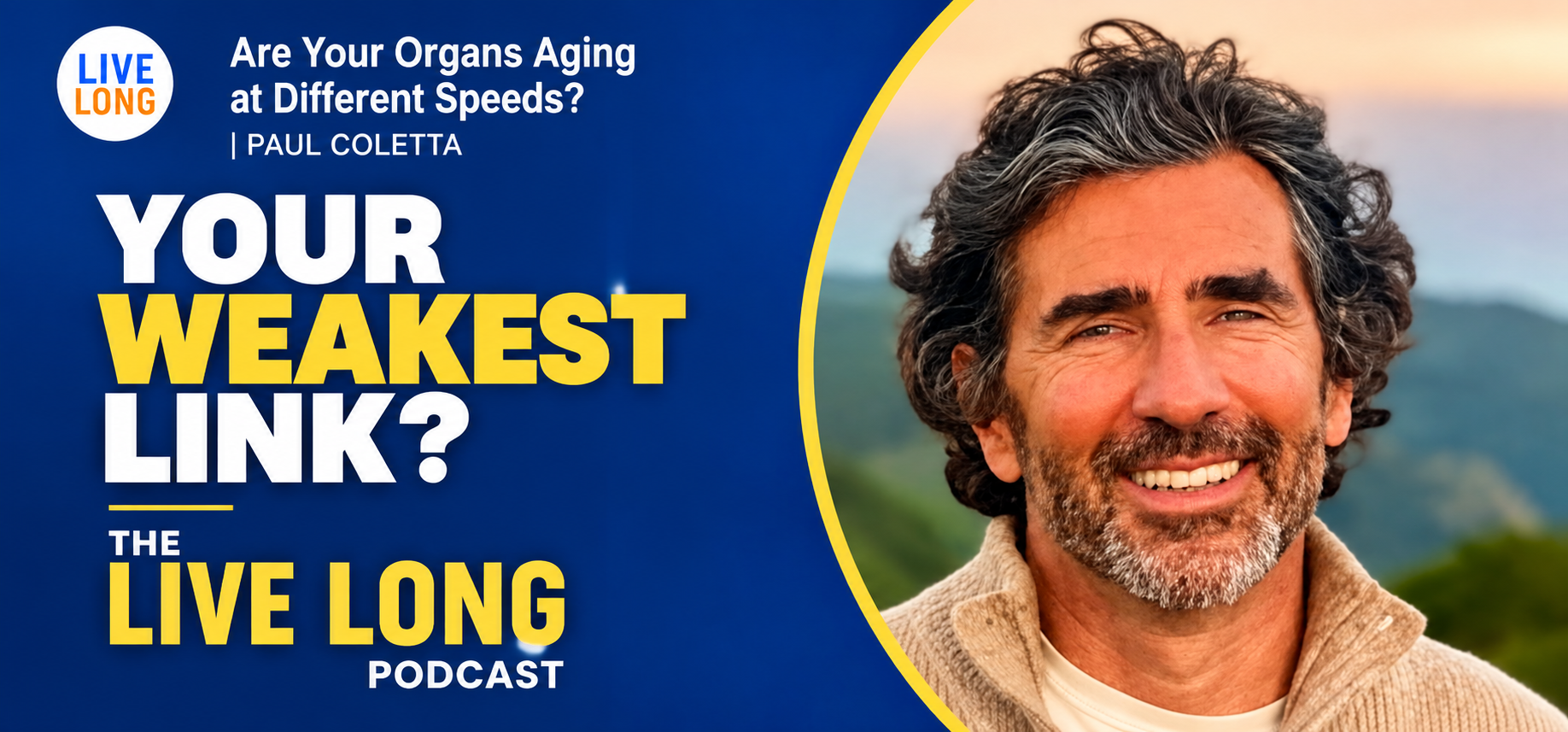
Vero co-founder and CEO Paul Coletta joined Peter Bowes on Live Long for a wide-ranging conversation on organ-level aging, self-experimentation, and where the line sits between healthy optimization and over-testing.
Eleven organs, one blood draw
OrganAge reads a single vial of blood plasma against organ-specific proteomic models, returning a separate biological age for each of 11 organs rather than one blended score. Coletta pointed to the brain in particular as what he calls the "gateway organ" — the one with the broadest downstream influence on the rest of the body.
A kidney result that changed a daily habit
Coletta's own test flagged his kidney as his most accelerated organ. A follow-up ultrasound found a benign cyst — a finding that led him to reassess something as basic as his water intake, and adjust it. It's a small, concrete example of the thing Coletta and Bowes spend much of the episode circling: a result only matters if it changes what you actually do next.
Does measurement change behavior?
That question — whether simply measuring something is enough to drive real behavior change, or whether it takes more than a number on a screen — runs through the second half of the conversation, alongside Coletta's own self-experimentation with creatine, sunlight, and sleep.
"It's the quality of energy and vitality that I want to have. We are already living older." — Paul Coletta
Where the science stands
Coletta was direct about timelines: he expects broader availability sometime in late 2027 or early 2028, and was clear that clinical validation remains the priority before then — not a box to check after the fact.
Listen to the full conversation on YouTube, including Coletta's take on when health optimization goes too far, and his own daily longevity stack.
Early access
Discover your OrganAge™
Join our waitlist to get priority access to OrganAge™ and Vero Compass™ as they become more widely available.
Get early accessEarly access
Discover your OrganAge™
Join our waitlist to get priority access to OrganAge™ and Vero Compass™ as they become more widely available.
Get early access