

Organ Science
Key takeaways
- Whole-body biological age scores can mask a single failing organ — Coletta's own test read nine years younger overall while his kidney tested seven years older, with normal standard bloodwork.
- Organ-level proteomic testing reads real-time biology rather than genetic predisposition, catching changes before symptoms or standard labs do.
- Vero's mission is closing the loop: bridging a health insight to a targeted intervention, then retesting to validate the outcome.
- New "cell clock" technology aims to reveal not just which organ is aging fastest, but the mechanistic pathways behind it.
- The near-term goal is bringing the assay's cost down from a full 11,000-protein panel to a focused ~300-protein panel, making organ-level testing broadly accessible.
A vanity metric that missed the real story
Vero co-founder Paul Coletta sat down with Dr. Jeremy Koenig on The DNA of Things (Episode 124) to talk about a problem most biological-age tests don't solve: they average everything together.
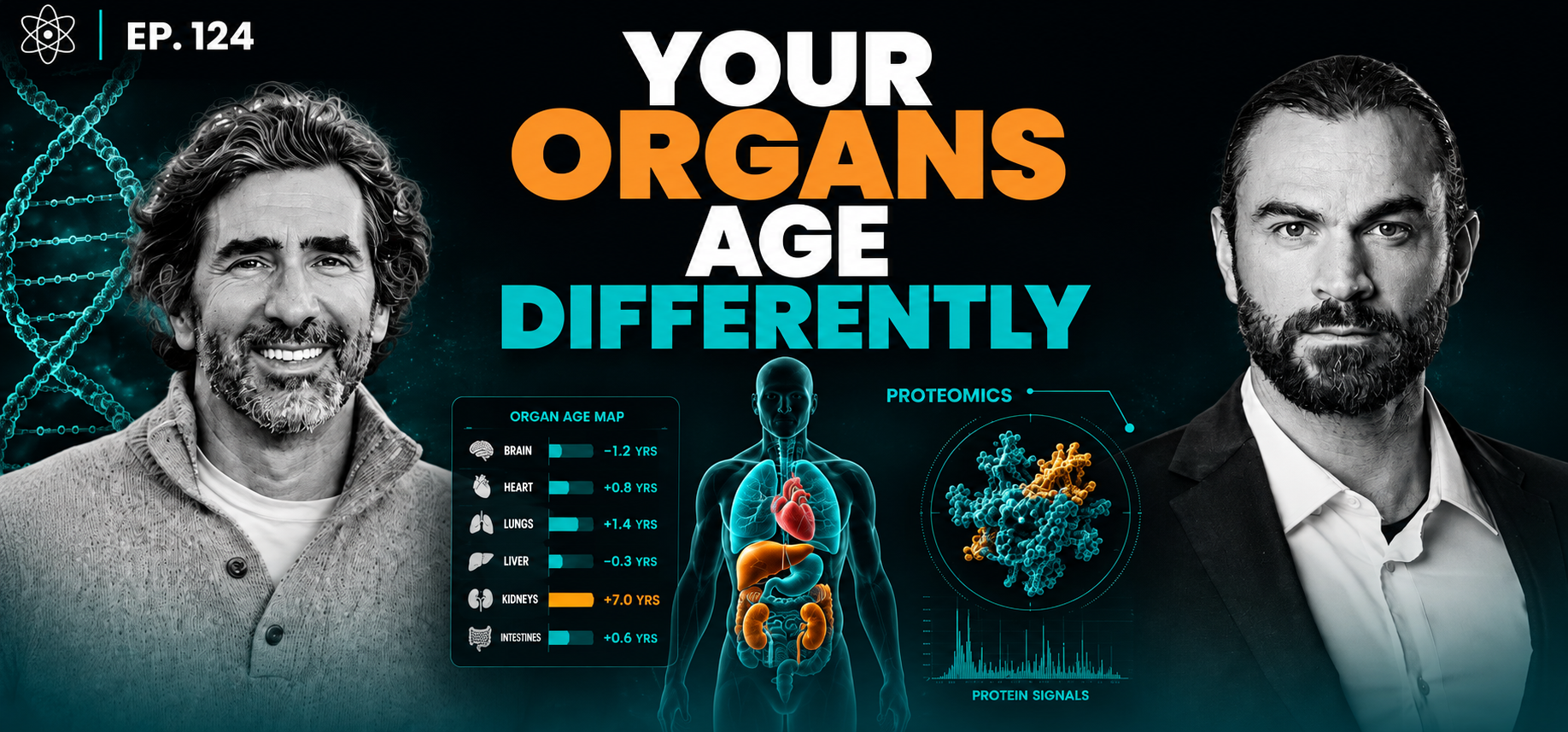
Coletta's own experience is the clearest example. A popular wearable told him he was nine years younger than his chronological age — "a great vanity metric," as he put it, but not one he could act on. Around the same time, an early proteomic organ-age test flagged something very different: his kidney was testing seven years older than he was. His standard bloodwork looked completely normal. It wasn't until a friend ran an ultrasound that a benign but age-related renal cyst turned up — asymptomatic, and invisible to the whole-body average.
"You don't die organismally, you die at an organ level. So wouldn't you want to know your most accelerated organ? Wouldn't you want to know your weakest link?" — Paul Coletta
One blood draw, read organ by organ
That's the premise behind Vero's OrganAge™ test: one blood draw, read against organ-specific proteomic models built from Stanford research (published in Nature and validated in a 45,000-person UK Biobank cohort), returning a separate biological age for each of 11 organs rather than one blended number.
What's next: more precision, lower cost
Coletta also previewed where the science is headed next — cell clock technology, which aims to explain not just which organ is aging fastest, but why, by pointing to specific cellular pathways an intervention could target. And he was candid about cost: the full assay is expensive today, but the near-term goal is a focused ~300-protein panel that brings it under $100–$200, closing the loop between insight, intervention, and a retest that confirms whether it actually worked.
Listen to the full conversation on YouTube, including Coletta's path from a decade at Disney to founding Vero, and his own N-of-1 experiments tracking his brain clock.
Early access
Discover your OrganAge™
Join our waitlist to get priority access to OrganAge™ and Vero Compass™ as they become more widely available.
Get early accessEarly access
Discover your OrganAge™
Join our waitlist to get priority access to OrganAge™ and Vero Compass™ as they become more widely available.
Get early access